Florida Auto Insurance in 2026: What You Must Carry, What "Full Coverage" Means and How to Pay Less
Updated October 24, 2026 · By the Arte Insurance team · 8-minute read
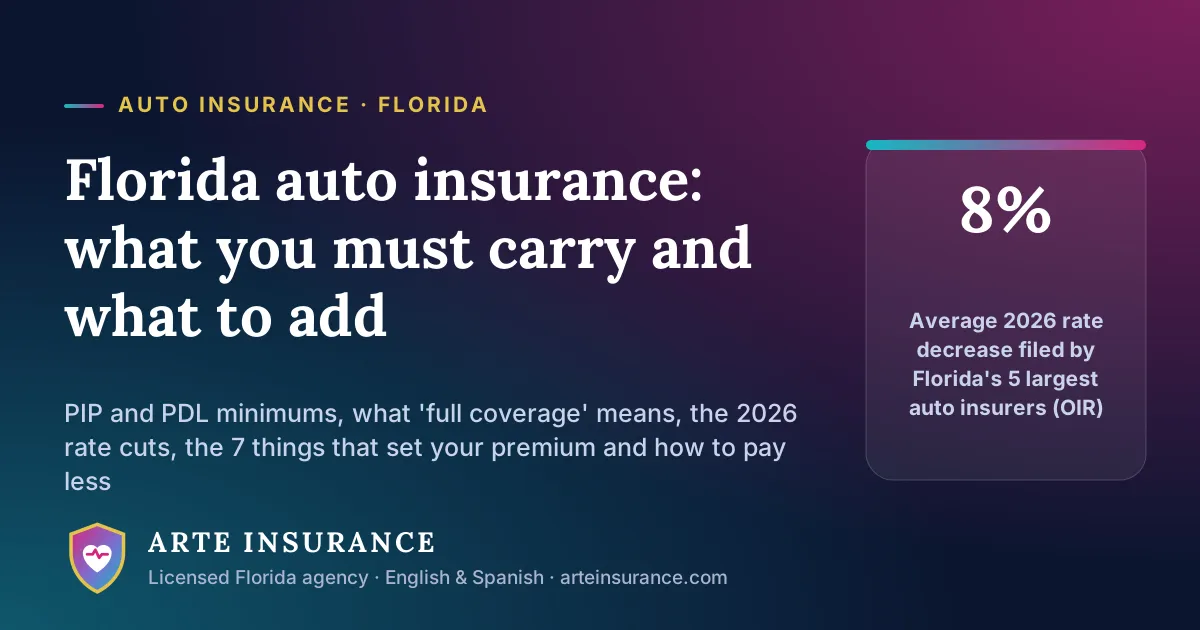
Florida requires only two coverages to register a car: $10,000 of personal injury protection (PIP) and $10,000 of property damage liability (PDL). That minimum pays your own medical bills after a crash and the damage you cause to someone else’s car; it pays nothing for the people you injure, nothing for your own car, and nothing if an uninsured driver hits you. About one in five Florida drivers has no insurance at all. The good news for 2026: after two years of reforms, the five largest auto insurers in the state (78% of the market) filed an average 8% rate decrease, and the regulator expects nearly 80% of policyholders to pay less. That makes this the year to compare.
Updated: October 24, 2026 · Source: Florida Office of Insurance Regulation, March 5, 2026
Families in Hialeah, Miami and across Florida ask us the same two things: “What do I have to carry?” and “Why is my renewal so high?” This guide answers both, explains what “full coverage” really means, and lists the steps that lower the premium without leaving you exposed after a crash.
What Florida requires (and what it doesn’t)
Florida is a no-fault state. To register a vehicle with four or more wheels you must carry:
- Personal injury protection (PIP): $10,000. Pays your own medical bills and lost income after a crash, no matter who caused it: generally 80% of reasonable medical expenses and 60% of lost wages, up to the limit. Two rules matter: you must get medical care within 14 days of the accident, and without a doctor’s emergency medical condition finding, the medical benefit is capped at $2,500.
- Property damage liability (PDL): $10,000. Pays for damage you cause to someone else’s car, fence or building.
What the law does not require for most drivers is bodily injury liability, the coverage that pays when you injure someone else. Without it, the other person’s lawyer comes after you, your savings and your wages. Drivers with certain violations (a DUI, for example) must carry it and file an FR-44 or SR-22 certificate with the state.
Did Florida repeal no-fault? No. Bills to end PIP were filed again in the 2025 and 2026 sessions and did not pass; the only repeal that cleared the Legislature, in 2021, was vetoed. As of October 2026, PIP and PDL are still the minimum.
What “full coverage” means in Florida
There is no policy called “full coverage.” Agents use the phrase for a policy that adds the protections the law leaves out:
- Bodily injury liability (BI). Pays for injuries you cause to others. Common limits are $25,000 per person / $50,000 per accident, $50,000/$100,000 or $100,000/$300,000. This is the coverage that protects your assets.
- Uninsured/underinsured motorist (UM). Pays for your injuries and your passengers’ when the driver who hits you has no insurance or too little. Florida insurers must offer it; you can only reject it in writing. With roughly 20% of Florida drivers uninsured, it is the coverage we recommend most often.
- Collision. Repairs your car after an accident, whoever is at fault, minus your deductible.
- Comprehensive. Theft, vandalism, fire, falling trees, animals and flood damage to your car. In Florida this is the hurricane coverage.
- Extras: medical payments (MedPay), rental reimbursement, roadside assistance, gap coverage for a financed car.
If you finance or lease the car, the lender requires collision and comprehensive. If the car is paid off and worth little, dropping collision can make sense; dropping BI and UM almost never does.
What’s happening with prices in 2026
After the 2022 and 2023 litigation reforms, Florida’s auto market turned around. According to the Office of Insurance Regulation (March 2026), the five largest groups (Progressive, GEICO, State Farm, Allstate and USAA, together 78% of the market) requested an average 7.4% decrease in 2025 and have indicated an average 8% decrease for 2026; one group filed for −16.5%. Progressive issued nearly $1 billion in credits to policyholders, State Farm paid a $533 million dividend (about $173 per vehicle), GEICO’s reductions reach more than 700,000 customers from April 2026, USAA cut rates 7%, Allstate 7% for 171,000 drivers, and AAA 15% over three filings. Florida’s personal auto liability loss ratio was 52.5% in 2025, the lowest in 15 years.
Two cautions. Decreases are not spread evenly: your renewal depends on your own record, ZIP code and car, and an insurer that cut rates for one group of drivers may not have cut yours. And Florida still pays more than most states for the same car, because of uninsured drivers, dense traffic, a high claims history and storm exposure.
The 7 things that set your premium
- Your driving record. Tickets and at-fault accidents in the last 3 to 5 years weigh most. A DUI changes everything.
- Where the car sleeps. Miami-Dade and Broward ZIP codes carry some of the highest rates in the country because of theft, claims and lawsuits.
- The car. Repair cost, theft rate, safety features. A late-model SUV with sensors costs more to fix than it did five years ago.
- How much you drive. Commuting 40 miles a day costs more than driving to the grocery store.
- Who’s on the policy. A 17-year-old driver can double the premium; a spouse with a clean record can lower it.
- Your insurance history. A lapse in coverage, even one month, marks you as a higher risk for years. Florida also lets insurers use a credit-based insurance score.
- The coverage and deductibles you choose. Higher BI and UM limits cost surprisingly little more; a $1,000 collision deductible instead of $500 lowers the premium noticeably.
How to pay less without leaving yourself exposed
- Compare at every renewal, especially this year. With most big insurers cutting rates at different times, the cheapest company for you in 2024 is not necessarily the cheapest in 2026. An independent agent quotes several at once.
- Ask for the discounts you already qualify for: bundling with home or renters insurance, paying the term in full, paperless billing, a defensive-driving course, good student, low mileage, and telematics programs that track your driving (only if you drive carefully).
- Raise the collision and comprehensive deductibles to an amount you have saved.
- Drop collision on an old car if its value is close to what you’d pay in premium and deductible over a couple of years. Keep comprehensive if you can: it’s cheap and it covers storms and theft.
- Never let the policy lapse. If your insurer cancels you for non-payment, the state can suspend your license and registration, and getting back on the road means a reinstatement fee plus years of higher premiums. If money is tight, call before the due date: moving the payment date or adjusting coverage is better than a lapse.
- Review before hurricane season. Insurers stop writing new policies and changes once a watch or warning is issued. Make sure comprehensive is on the policy by June 1.
Frequently asked questions
Is the state minimum enough?
It keeps you legal. It does not protect your savings if you injure someone, pay to fix your own car, or help if an uninsured driver hits you. For most families, BI, UM and comprehensive are the three coverages worth adding first.
I was hit by a driver with no insurance. Who pays?
Your PIP pays your first medical bills (80%, up to $10,000). Beyond that, only your own uninsured motorist coverage pays for your injuries, and only your collision coverage repairs your car.
Does my personal policy cover Uber, Lyft or deliveries?
Usually not while the app is on. Rideshare companies provide some coverage between trips and more during a trip, but there are gaps; ask about a rideshare endorsement.
What is an SR-22 or FR-44?
Certificates your insurer files with the state to prove you carry the coverage a court or the DHSMV requires after certain violations. An FR-44 (after a DUI) requires much higher liability limits. We work with insurers that file them.
Can I insure a car if I don’t have a Florida license yet?
Many insurers write policies for drivers with a foreign license or an international permit; the options and prices vary. Ask us before you buy the car.
We compare your car with several insurers
We are a private insurance agency licensed in Florida (license L116417), based in Hialeah, helping families across the state by phone and online. We review what you carry today, quote your car with several insurers, explain every coverage in English or Spanish, and tell you plainly where you are exposed. The insurer sets the premium; you don’t pay more with an agent.
Request an auto insurance quote or call (786) 808-1802.
Arte Insurance is a private insurance agency licensed in Florida (license L116417). This article is general information, not legal or financial advice. Coverages, limits, discounts and requirements vary by insurer and policy; check your contract and talk to a licensed agent about your situation.
Sources: Florida Office of Insurance Regulation: auto rate decreases for the top 5 groups (March 5, 2026) · Florida Realtors: auto insurance rates trending lower (March 6, 2026) · Florida Statutes, s. 627.736 (PIP benefits) · Florida Statutes, s. 324.022 (property damage liability) · Florida Statutes, s. 627.727 (uninsured motorist coverage) · Florida Highway Safety and Motor Vehicles: insurance requirements · Insurance Research Council: uninsured motorists