2027 at a glance
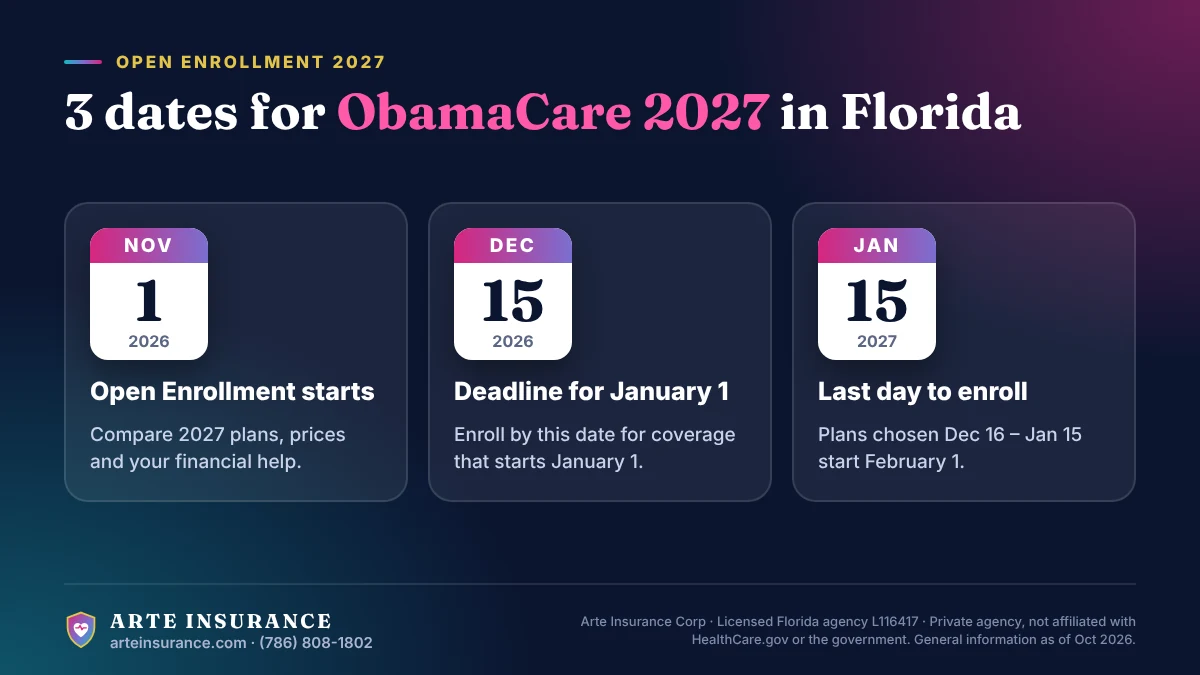
- Open Enrollment
- November 1, 2026 – January 15, 2027
- Coverage from January 1
- Enroll by December 15, 2026
- Enroll Dec 16 – Jan 15
- Coverage starts February 1, 2027
- Financial help
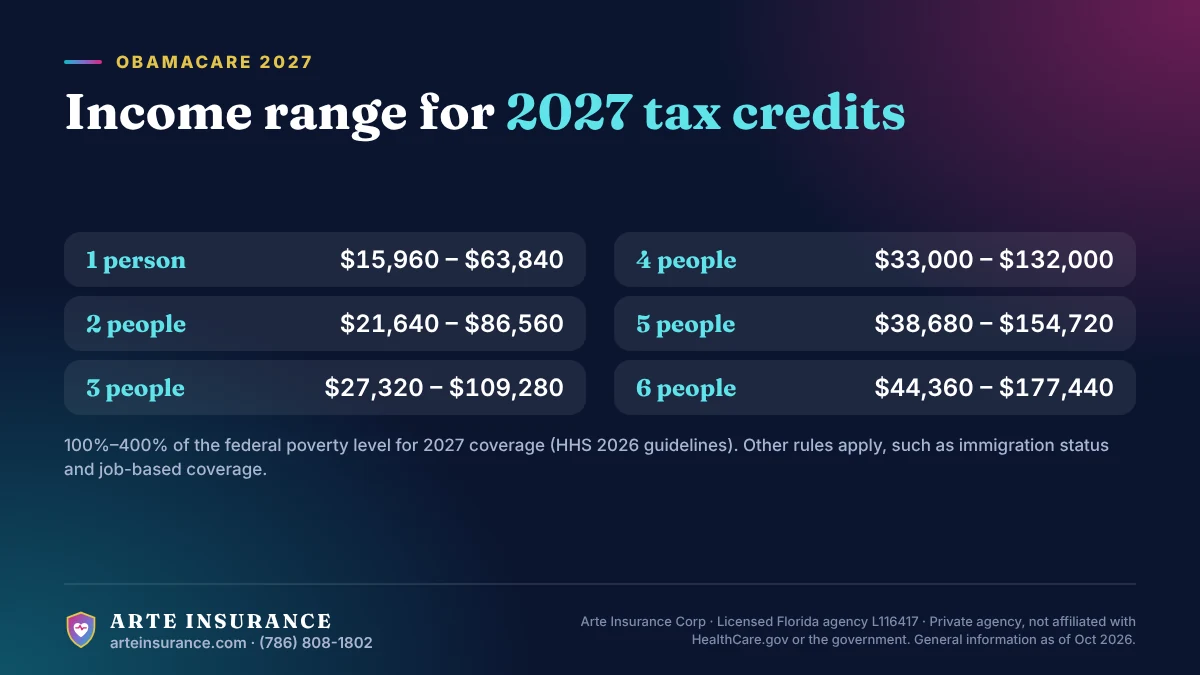
- Generally for household income of 100%–400% of the federal poverty level
- 400% of poverty level
- $63,840 for 1 person · $132,000 for a family of 4
- Out-of-pocket maximum
- $12,000 individual · $24,000 family (some plans are lower)
- Florida's Marketplace
- HealthCare.gov (the federal platform)
What ObamaCare is
"ObamaCare" is the everyday name for health coverage sold through the Health Insurance Marketplace® created by the Affordable Care Act (ACA). Florida uses the federal Marketplace at HealthCare.gov.
Every Marketplace plan covers the ACA's essential health benefits — including doctor visits, emergency care, hospital stays, maternity and newborn care, mental health services, prescription drugs and children's care. Insurers can't deny you or charge you more because of a pre-existing condition, and many preventive services, like recommended screenings and vaccines, are covered with no copay when you use an in-network provider.
Who can buy a Marketplace plan
To enroll you generally need to live in Florida, be a U.S. citizen or national or be lawfully present in the United States, and not be incarcerated. People who already have Medicare generally can't use the Marketplace. Getting financial help has extra requirements, explained next.
How financial help works in 2027
There are two kinds of savings:
- Premium tax credits lower your monthly premium. The amount is based on your expected household income and the cost of a benchmark Silver plan in your area. You can take the credit in advance each month or claim it when you file your taxes.
- Cost-sharing reductions lower deductibles, copays and the out-of-pocket maximum if your household income is between 100% and 250% of the federal poverty level and you choose a Silver plan.
The larger, temporary credits that were available from 2021 through 2025 expired. For 2027, the IRS sets how much of your income you're expected to contribute toward the benchmark plan:
| Household income (% of poverty level) | Expected contribution toward the benchmark plan |
|---|---|
| Up to 133% | 2.15% of income |
| 133% – 150% | 3.23% – 4.30% |
| 150% – 200% | 4.30% – 6.78% |
| 200% – 250% | 6.78% – 8.66% |
| 250% – 300% | 8.66% – 10.22% |
| 300% – 400% | 10.22% |
| Above 400% | No premium tax credit |
See your own number in 30 seconds. Our 2027 ObamaCare calculator shows your % of the poverty level and the most you’d pay for the benchmark Silver plan, plus the full 2027 income limits table.
To qualify you also generally need to: not have an affordable job-based plan, Medicaid or Medicare available to you; file taxes jointly if you're married (with limited exceptions); and have an eligible immigration status (see below).
Estimate your income carefully. Your credit is based on what you expect to earn. When you file taxes, you reconcile it with your actual income — and starting with the 2026 tax year there is no limit on how much excess credit may have to be repaid. Report income changes during the year.
If your household income is below 100% of the poverty level, you generally can't get premium tax credits, and because Florida has not expanded Medicaid, some adults in this range have few options. Call us — we'll review what may be available for your family, such as Medicaid for children and pregnant women or Florida KidCare.
2027 changes for immigrant families
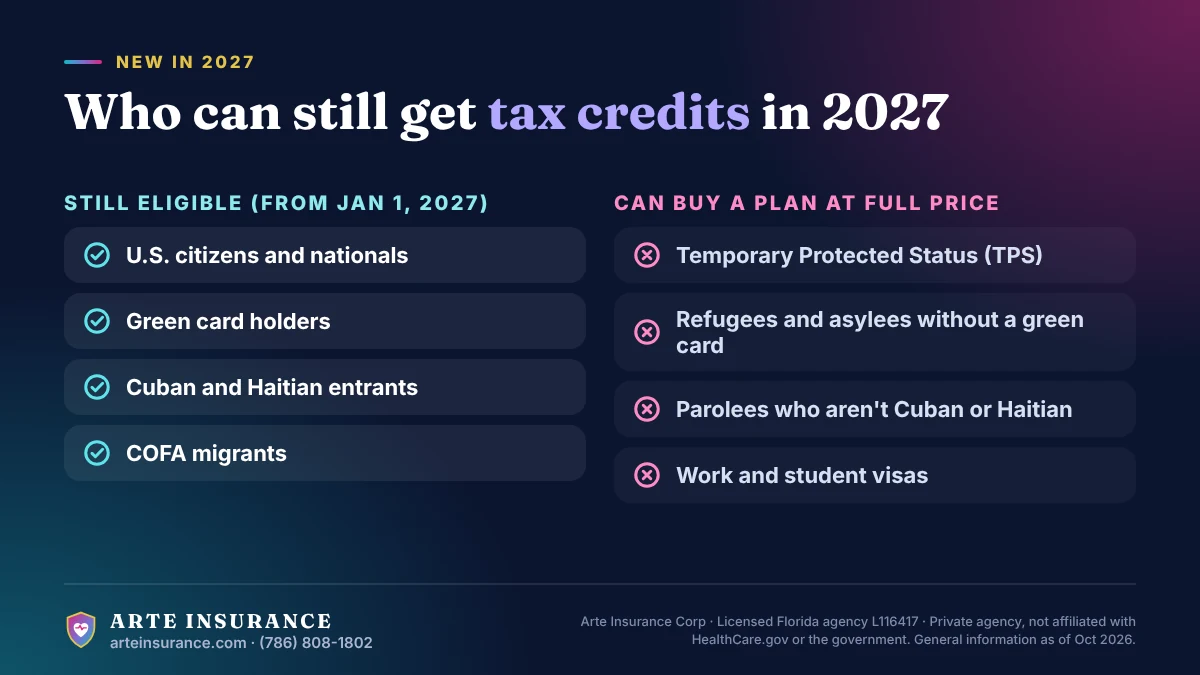
Starting January 1, 2027, federal law limits premium tax credits and cost-sharing reductions to:
- U.S. citizens and nationals;
- lawful permanent residents (green-card holders);
- Cuban and Haitian entrants — a legal category that includes Cuban and Haitian nationals who were paroled into the U.S., who are in removal proceedings, or who have a pending asylum application, unless they have a final order of removal;
- citizens of the Marshall Islands, Micronesia and Palau living in the U.S. under the Compacts of Free Association.
Many other lawfully present immigrants — including people with Temporary Protected Status (TPS), refugees and asylees who don't yet have a green card, parolees who aren't Cuban or Haitian, and people with work or student visas — can still buy a Marketplace plan in 2027, but at full price. DACA recipients are not eligible for Marketplace coverage.
What to do now: update your application during Open Enrollment so the Marketplace has your current documents. If your status can't be verified, you'll generally get 95 days to send proof. If you don't update, you could be renewed without financial help on January 1. For questions about your immigration case itself, talk to a qualified immigration attorney — we can explain how the Marketplace treats the documents you have.
Choosing a plan: metal levels and networks
Plans are grouped into metal levels that show how you and the plan share costs — not the quality of care:
- Bronze: lowest premiums, highest costs when you get care. On average the plan pays about 60% of covered costs.
- Silver: moderate premiums; about 70% on average. For most people, the only level that offers cost-sharing reductions.
- Gold: higher premiums, lower costs when you get care; about 80% on average.
- Catastrophic: for people under 30 or with a hardship exemption; very high deductible and no premium tax credits.
Networks matter as much as price. HMO and EPO plans usually cover only in-network care, while PPO plans may pay part of out-of-network costs. We check your doctors, hospitals and prescriptions before you decide.
When you can enroll
Open Enrollment runs from November 1, 2026 to January 15, 2027. Choose a plan by December 15 for coverage that starts January 1; plans chosen from December 16 to January 15 start February 1.
Outside Open Enrollment you need a Special Enrollment Period, usually triggered by a life event such as losing other health coverage, moving to a new area, getting married, having or adopting a child, or gaining an eligible immigration status. You generally have 60 days from the event to enroll. A change in income alone generally doesn't give you a new chance to enroll with financial help.
What to have ready
- Names, dates of birth and Social Security numbers (or immigration document numbers) for the people applying;
- your best estimate of 2027 household income — pay stubs, tax returns or business records help;
- information about any job-based coverage available to your household;
- your current plan, if you have one, plus your doctors and prescriptions.
How enrolling with Arte works
- A first call by phone, in English or Spanish.
- Your consent first. Federal rules require us to have your documented consent before we help with your Marketplace application. We'll ask you to confirm it in writing, and we keep that record as required.
- Review before we submit. We go over your application with you so you can confirm every answer, and you choose the plan.
- Help after enrollment with your first payment, document requests, changes during the year and next year's renewal.
Insurers pay licensed agents a commission for Marketplace enrollment. Premiums are the same as enrolling on your own at HealthCare.gov.
More questions
Can I get ObamaCare if I'm self-employed or paid in cash?
Yes. Self-employed people, gig workers and people paid in cash can buy Marketplace plans and may qualify for premium tax credits. You'll estimate your 2027 net income (after business expenses), so keep records of what you earn and spend. We help you build a realistic estimate.
What if my income changes during the year?
Report changes in income or household within 30 days. The Marketplace will adjust your premium tax credit, which helps you avoid owing money at tax time — starting with the 2026 tax year there is no cap on how much excess credit you may have to pay back.
Will my doctors and medicines be covered?
It depends on the plan. Each insurer has its own network of doctors and hospitals and its own list of covered drugs. Before you choose, we check your doctors, preferred hospitals and prescriptions against the plans you're considering.
What happens if my insurer is leaving Florida?
You'll receive a notice from your insurer. The Marketplace may automatically move you to a similar plan, but it may not include your doctors. The safest step is to compare plans and choose a new one by December 15 so your coverage continues on January 1.
Can I buy a Marketplace plan if my job offers insurance?
You can, but you generally won't get premium tax credits if your employer's plan is considered affordable and meets minimum value. For 2027, job-based coverage is considered affordable if the employee's share for self-only coverage is no more than 10.22% of household income; family members are evaluated based on the cost of family coverage.
I'm turning 65. Should I keep my Marketplace plan?
Most people should switch to Medicare when they become eligible, and financial help for a Marketplace plan generally ends once you qualify for Medicare Part A. Timing matters to avoid gaps and late-enrollment penalties, so talk with us a few months before your 65th birthday.
Can the tax credit cover my whole premium?
We don't promise prices. Your premium depends on your household's income, ages, county and the plan you choose, and the premium tax credit lowers it for many families. The premium also isn't your only cost: depending on the plan there can be deductibles, copays and coinsurance. A licensed agent reviews your case and shows you the real numbers before you choose.
Sources
- HealthCare.gov — Dates and deadlines for 2027 coverage
- HealthCare.gov — Immigration status and the Marketplace
- IRS Revenue Procedure 2026-26 (2027 applicable percentages)
- Federal Register — 2026 HHS poverty guidelines
- 26 U.S. Code § 36B — Premium tax credit (as amended in 2025)
This guide is general information, not tax, legal or immigration advice. Rules can change; we confirm current details with you before you enroll.